The Critical Clarity Blueprint for Faster Academic Decisions
Most academic initiatives don’t fail because the idea is weak. They fail because no one knows who actually makes the call. That one flaw turns “collaboration” into committee speed. Everyone gets a voice. No one owns the outcome. What industry ships in six weeks takes higher ed 18 months to “socialize.” This is a blueprint to fix that — without gutting shared governance or pretending universities should run like startups.
It’s about governance, authority, and execution. One lever: decision rights and accountability.
⸻
The Real Bottleneck Isn’t Strategy. It’s Authority.
When execution stalls, leadership teams usually blame:
· a broken process
· weak data
· lack of alignment
· not enough stakeholder input
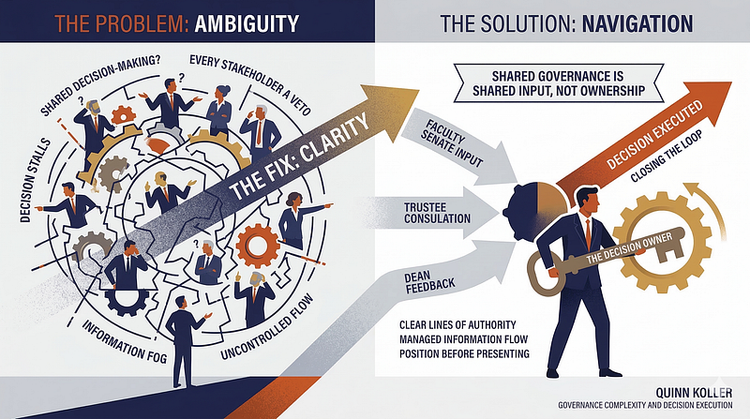
In practice, the cause is simpler: Everyone is involved. No one is accountable.
That’s not a people issue. It’s a design issue. And design issues don’t get fixed by adding another committee. They get fixed by naming who owns the decision.
⸻
The Hidden Cost of “Decision Theater”
Academic leaders lose about 12 hours a week in meetings where decisions are discussed but never made.
Across a mid-sized university:
· ~50 leaders
· 12 hours per week each
· = 600 hours per week in decision loops
That’s roughly 15 full-time roles spent on motion without progress.
What this looks like on campus:
· initiative proposed
· committee formed
· stakeholders consulted
· more committees formed
· six months later… no decision
That isn’t collaboration. It’s paralysis dressed up as inclusion.
⸻
Collaboration vs. Decision-Making: They’re Not the Same
Higher ed often treats these as interchangeable:
· gathering input
· reaching agreement
· making a decision
They aren’t.
Here’s the difference:
· Collaboration gathers expertise and perspective.
· Decision-making commits the institution to a path.
When collaboration replaces decision-making, you get:
· endless consultation
· political cover labeled “consensus”
· decisions delayed until the window closes
Then someone outside the process forces the outcome — accreditors, budget pressure, boards, state systems, market shifts.
⸻
The Blueprint: Three Roles. Name Them Clearly.
You don’t need fewer stakeholders. You need clearer roles.
1) Decider
· Owns the choice and the consequences
· One person
· Not a committee
· Not “Academic Affairs”
· Not “we”
2) Consulted
· Provides input that shapes the decision
· Expertise matters here
· Does not make the call
3) Informed
· Told what was decided
· Executes, coordinates, communicates
· No surprise vetoes after the fact
This preserves participation without sacrificing speed.
⸻
Example: Launching a New Program
The slow version:
“Academic Affairs will work with Faculty Senate to develop recommendations, pending input from IT, Student Services, and Budget.”
Translation: no one decides.
The faster version:
“Dr. Smith will decide whether to launch the AI certificate by March 15. She will consult IT, Student Services, and Budget. Faculty Senate will be informed of the decision and timeline.”
Same stakeholders. Different structure.
Clear ownership. Faster action.
⸻
Three Mistakes That Quietly Stall Execution
Even when leaders try to clarify decision rights, they slip into these patterns.
Mistake 1: Treating consultation like consensus
· Input turns into required agreement
· Every concern becomes a blocker
· Consultation becomes negotiation
Better: gather input. Then decide.
Mistake 2: Multiple deciders
· “The committee will decide.”
· “We’ll decide as a group.”
· “Let’s see where we land.”
In reality, no one decides.
Mistake 3: No deadline
Without a date:
· consultation drags on
· more data gets requested
· urgency fades
Deadlines aren’t pressure. They’re clarity.
⸻
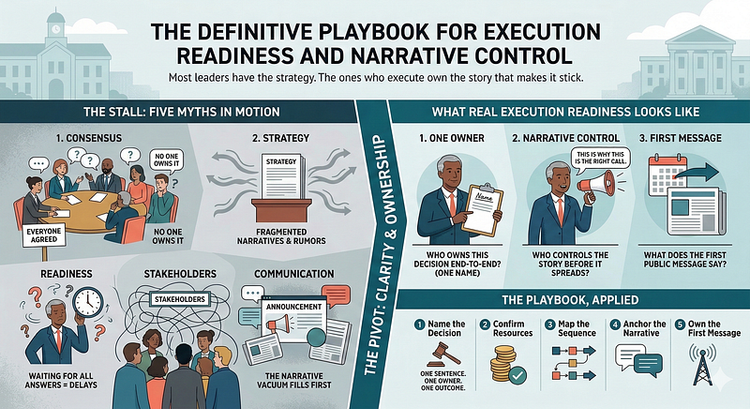
Five Myths That Stall Campus Decisions
These beliefs sound responsible. They feel safe. They also keep decisions stuck.
Myth 1: More input means better decisions
More input often means slower decisions. Input without ownership creates meetings, not outcomes.
Myth 2: Consensus protects you politically
Consensus spreads blame. It doesn’t reduce risk. It delays accountability.
Myth 3: Decision rights belong in policy manuals
Policy means little without named owners. If everyone is responsible, no one is.
Myth 4: Faculty governance covers academic decisions
Faculty governance covers curriculum. It rarely covers portfolio math, program viability, or resource trade-offs.
Myth 5: Clarity about authority creates conflict
Ambiguity creates conflict. Clarity just surfaces it sooner — when you can still act.
The institutions moving fastest aren’t the ones with the best plans.
They’re the ones that know who decides what.
⸻
Alignment Is a Feeling. Clarity Is Structure.
Many leadership teams operate on this belief: “Get alignment, then act.” It sounds reasonable. It’s expensive.
When a program needs to be cut or restructured and the math is clear:
· convene a task force
· gather more input
· wait for consensus
· revisit the data
Months pass. Nothing changes. The numbers get worse.
A better belief:
“Name the decider, then act.”
Alignment asks everyone to agree.
Clarity asks:
· Who owns this decision?
· What input do they need?
· When is the deadline?
One stalls. The other moves.
⸻
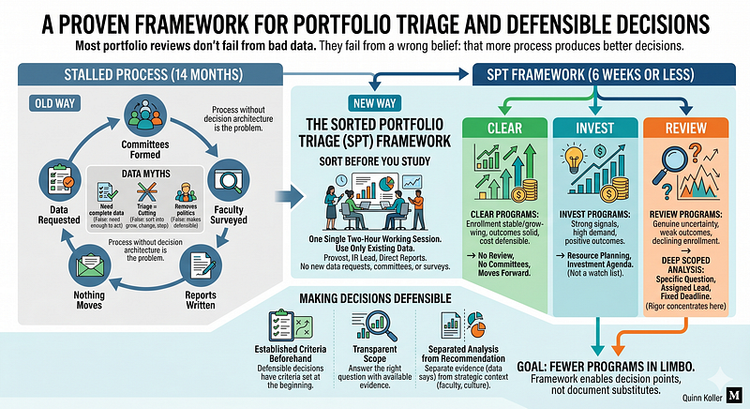
One Practical Fix: Identify the Decision Type
Most leaders think they need a new process. They don’t. They need to identify the type of decision — and who owns it.
There are four types:
· Decide alone — one person owns it
· Decide with input — one person decides after consulting
· Decide together — consensus required
· Decide and inform — act, then notify
Universities mix these up constantly. A “decide alone” call gets run like “decide together.” It lands in committee. More data gets requested. Six weeks pass. The semester shifts. The moment is gone.
If a decision is stalled, ask:
· What type of decision was this meant to be?
· Who owns it?
· What’s the deadline?
If no one can answer clearly, that’s the issue.
⸻
Why Teams Don’t Fix Decision Rights
Leaders aren’t lazy. They get stuck on objections that sound reasonable. They aren’t.
Objection 1: “We need more data.”
You’ve seen the data:
· completion rates
· cost per program
· enrollment trends
More data won’t make the decision easier. It will make it later.
Objection 2: “Faculty won’t accept it.”
Faculty resist what they don’t own. They accept what they help shape.
Sequence matters:
· involve faculty early (consulted)
· name the decider
· set the timeline
Resistance drops when the process is real.
Objection 3: “Now isn’t the right time.”
There is no perfect time.
There is only:
· before scrutiny, when you have options
· after scrutiny, when someone else decides
The objections aren’t the problem.
Believing them is.
⸻
Why This Works in Academic Culture
This framework doesn’t weaken shared governance. It protects it.
It separates:
· input gathering (where faculty expertise belongs)
from
· deciding (where accountability must live)
Faculty shape the decision through consultation. One person takes responsibility for the call.
When responsibility is visible:
· execution speeds up
· trust improves because decisions actually happen
· politics become manageable because the rules are clear
⸻
Start Here: A 90-Day Decision Rights Sprint
You don’t need a campus overhaul. Start with three decisions your institution must make in the next 90 days.
For each one, write:
· Decider: one name
· Deadline: one date
· Consulted: who provides input
· Informed: who needs to know and execute
That’s it. Clarity is structure. Use it.
⸻
The Bottom Line
Good decisions made quickly beat perfect decisions made slowly. Excellence comes from iteration, not endless consultation. The framework is simple. The question is whether we’ll use it.
We should.