The Practical Guide to Board Dynamics and Shared Governance Navigation
Most institutions don’t have a governance problem. They have an ambiguity problem dressed up as one.
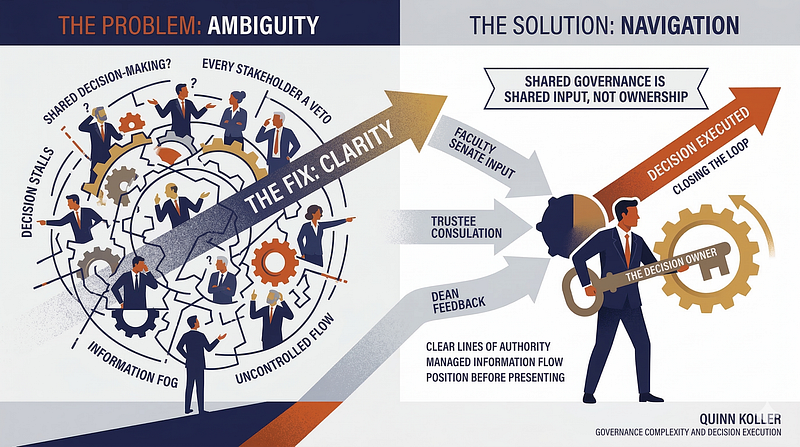
I work with university presidents and provosts navigating some of the hardest governance terrain in higher education. The patterns repeat. Smart leaders with clear vision and real urgency watch good decisions die in committee. Not because boards are difficult. Not because faculty senates are obstructionist. Because nobody knows who owns the decision, and nobody controls the information flow.
Shared governance is not the obstacle. It never was. Unclear authority, unmanaged information, and misunderstood roles are the obstacles. This guide is about fixing those three things.
The Five Myths That Keep Leaders Stuck
Before you can navigate governance well, you need to unlearn what’s slowing you down. These five myths show up in almost every institution I work with. They feel true because governance is complex. But complexity is not the enemy. Unclear authority is.
Myth 1: Shared governance means shared decision-making.
It doesn’t. Shared governance means shared input. One person still owns the call. When leaders treat every voice as a co-decision-maker, decisions stall. Every stakeholder becomes a veto. The institution stops moving. The fix is not less input. It is a clear line between who contributes to a decision and who makes it.
Myth 2: More consultation produces better decisions.
More consultation produces slower decisions. Quality comes from the right voices at the right time, not all voices at every stage. Leaders who over-consult are usually trying to build consensus before they act. That sounds responsible. In practice, it diffuses ownership so thoroughly that nobody can be held accountable when the decision either succeeds or fails.
Myth 3: Strong board relationships prevent hard conversations.
They don’t prevent them. They enable them. A trusted relationship is where hard truths land cleanest. Presidents who avoid difficult discussions because “the relationship is going well” are confusing comfort with progress. The relationship exists to carry weight. Use it.
Myth 4: Faculty resistance means the idea is wrong.
It usually means ownership is unclear. Faculty push back hardest when they feel managed rather than heard. But “heard” does not mean “given a veto.” When roles are clear, when input has a defined channel and a defined endpoint, resistance drops. Not because the idea changed. Because the process became legitimate.
Myth 5: Governance reform requires a policy overhaul.
It requires clarity on one thing: who closes the loop. Most governance structures are fine. The policies are adequate. The bylaws work. What’s missing is a named owner for each decision, with clear authority to move it forward after input is gathered. You don’t need new policy. You need one sentence: “This person decides, by this date, after consulting these people.”
The Three Mistakes That Cost the Most
Even leaders who see through the myths still make predictable errors when they enter the boardroom or sit down with the faculty senate. These three mistakes show up repeatedly.
Mistake 1: Treating shared governance as consensus.
Shared governance defines who gets input. It does not require unanimous agreement. When leaders confuse the two, the institution enters a permanent holding pattern. Every decision requires everyone’s approval. No one moves because no one can. The distinction between input and ownership is not semantic. It is the difference between a functioning institution and a stalled one.
Mistake 2: Presenting before positioning.
Walking into a board meeting cold is a gamble. Most leaders lose it. Trustees want to look informed, not surprised. Faculty senates want to feel heard, not managed. When a president presents a major initiative and the room hears it for the first time, the dynamics shift from evaluation to reaction. Reactions are harder to manage than prepared responses. Position before you present. The room should already know where it’s landing before you open the slide deck.
Mistake 3: Owning the relationship, not the decision.
Good board relationships feel like progress. They aren’t the same thing. A president can have full trustee trust and still watch a critical initiative die in committee. Relationships create access. Decision rights create outcomes. The president who spends energy building rapport but never clarifies who decides what, by when, will be well-liked and strategically stuck.
The Fifteen-Minute Fix: Brief Before You Present
This is the single most practical change a president or provost can make to their governance navigation. It is not a pre-meeting. It is a structured pre-conversation, and it takes about fifteen minutes per key stakeholder.
Here’s how it works:
Identify the two or three voices that carry the most weight in the room. These are not always the loudest people. They are the ones who shape the direction of discussion when they speak.
Share the core tension early. Don’t walk them through the entire proposal. Name the one question the decision hinges on. Let them sit with it before the formal meeting.
Name the decision you need made. Not the topic. Not the issue. The specific outcome you are asking the board or senate to approve.
Let them react before the room does. Give them space to raise objections privately. Surface what you can address. Adjust what you need to adjust.
This does three things. It removes surprise from the equation. Trustees and faculty leaders who feel blindsided become opponents, even when they agree with the substance. It surfaces objections you can address before they become public positions that are harder to walk back. And it builds a coalition before the vote, turning the formal meeting from a debate into a confirmation.
The meeting is not where you win board support. It is where you collect it.
The Core Distinction: Input Is Not Ownership
Most governance dysfunction traces back to one blurred line. Everyone knows who gets a voice. Nobody knows who closes the loop.
Shared governance tells every stakeholder they have a seat. It does not tell any of them who stands up at the end and says, “Here’s what we’re doing.” That gap is where leaders get lost.
When you name the owner, the process starts moving. Not because people stop caring about the outcome. Because they finally know their role. Input contributors know their job is to contribute, not to approve. Decision owners know their job is to listen, decide, and act. The institution knows where accountability lives.
Input is not ownership. Ownership is not consensus. Once you see that distinction clearly, stuck becomes solvable.
Putting It Together: A Navigation Framework
Board and shared governance navigation is not a single skill. It is a set of coordinated practices. Here is how they fit together.
Before any major decision reaches a formal body:
Name the decision in one sentence. Not the topic area, not the strategic priority. The specific choice that needs to be made.
Assign one owner. This is the person who will make the call after input is gathered. Not a committee. Not a working group. One name.
Define the input channels. Who gets consulted, in what format, by what date. Make the process explicit so nobody can claim they weren’t heard.
Brief the key voices. Use the fifteen-minute pre-conversation method. Remove surprise. Surface objections. Build alignment before the formal session.
In the room:
Present the decision, not the data. The room should hear what you are asking them to approve, not a literature review of the problem. Data supports the decision. It does not replace it.
Manage information flow, not relationships. The difference between a productive board meeting and a derailed one is usually whether the right people had the right information at the right time. When trustees and faculty leaders feel informed early, resistance drops. When they feel surprised, the boardroom becomes a courtroom.
After the decision:
Close the loop publicly. Announce what was decided, by whom, and what happens next. Ambiguity after a decision is made is almost as damaging as ambiguity before.
The System Is Not Your Enemy
Shared governance is not quicksand. It is a structure. Structures can be navigated.
The leaders who navigate governance well are not the ones with better boards or more cooperative faculty senates. They are the ones who stopped fighting the structure and started using it. They name owners. They brief before they present. They separate input from decision-making. They control information flow.
The governance structure starts working for you the moment authority becomes clear. The ambiguity is the problem. Remove it, and the system does what it was designed to do.
Quinn Koller works with presidents and provosts navigating governance complexity and decision execution. If board dynamics or shared governance friction are costing your institution time, he is open to a short, off-the-record conversation.