A Proven Framework for Portfolio Triage and Defensible Decisions
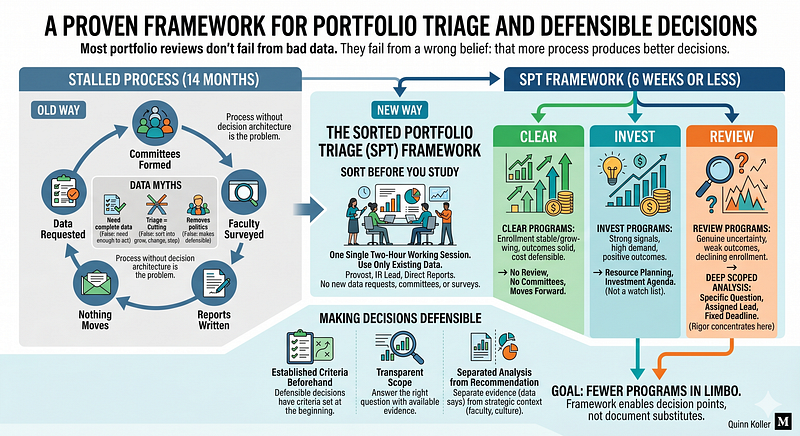
Most portfolio reviews don’t fail from bad data. They fail from a wrong belief: that more process produces better decisions.
After advising presidents and provosts across dozens of institutions, I’ve watched the same pattern repeat. Committees are formed. Data is requested. Faculty are surveyed. Reports are written. Six months pass. Sometimes fourteen. Nothing moves.
The problem isn’t the people. The problem is process without decision architecture.
This article lays out the framework I use with senior leaders to cut through that paralysis. I call it the Sorted Portfolio Triage (SPT) Framework. It’s not a software tool. It’s not a rubric. It’s a sequenced decision logic that turns a stalled review into a completed one, typically in six weeks or less.
Why Portfolio Reviews Stall
Three myths drive most of the dysfunction I encounter. They don’t look like myths from the inside. They look like rigor.
Myth one: You need complete data before you can decide. You don’t. You need enough data to act. Perfect information is delay with a better name. Institutions that move don’t have more data. They stopped believing that certainty is a prerequisite for decisions.
Myth two: Triage means cutting programs. It doesn’t. Triage means sorting. Some programs grow. Some change. Some stop. The output of triage is not a termination list. It’s a decision map that tells you where to invest analytical energy and where you can stop spending it.
Myth three: A good framework removes politics. No framework removes politics. A good one makes decisions defensible, even after the politics play out. That’s the actual goal: not a frictionless process, but a decision that holds up when challenged.
Each myth sounds careful. Each one functions as a stalling mechanism. If you’ve been in a portfolio review that lasted more than six months without producing decisions, at least one of these myths was doing the work.
The Core Principle: Sort Before You Study
The most expensive mistake in portfolio review is treating every program as equally uncertain.
Most programs aren’t uncertain. They’re obviously stable, obviously growing, or obviously struggling. Giving all three the same review depth wastes time, burns political capital on settled questions, and fatigues the faculty and staff whose input you’ll actually need later.
The SPT Framework is built on one principle: sort before you study.
Before any deep analysis, before any committee convenes, before any new data is requested, sort every program into one of three buckets using only data you already have.
The Three Buckets
The buckets are not evaluative judgments. They are decision categories that determine what happens next.
Clear. These programs don’t need a review. Enrollment is stable or growing. Completion rates are solid. Cost per completer is defensible. They pass a basic threshold test. They move forward without committee review, without extended debate, without additional data requests. Declaring something “clear” is an act of discipline. It means you’ve decided not to study it, and that’s the right call.
Invest. These programs show signal. Demand is real. Outcomes are positive. The opportunity gap is visible. These programs need a different kind of attention: not review, but resource planning. What would growth require? What’s the investment case? This bucket produces a prioritized investment agenda, not a watch list.
Review. These programs have genuine uncertainty. Enrollment is declining or volatile. Completion rates are weak. Cost per completer is hard to defend. The workforce signal is unclear. These programs get the deep analysis. Real questions with real decision deadlines. This is where your IR team’s time goes. This is where faculty conversations matter. This is where the political work happens.
How to Execute the Sort
The sort happens in a single working session. Two hours, maximum. The participants are limited: typically the provost, one or two direct reports, and an IR lead with access to existing institutional data.
The data inputs are constrained deliberately. You use only what you already have: three-year enrollment trends, completion rates, cost per completer, and one external signal, either labor market demand data or a recent program review if one exists. No new data requests. No pre-read committees. No surveys.
Every program gets sorted. Not just the ones that feel controversial. All of them.
When a program lands in a genuinely ambiguous place, it goes to Review. Ambiguity is not a reason to delay sorting. It’s the definition of a Review-bucket program.
After the session, the output is a sorted list, not a report. Clear and Invest programs have a decision recorded next to them. Review programs have a specific question assigned, a lead assigned, and a deadline assigned. That is the only documentation produced at this stage.
The Review Bucket: Where Rigor Actually Belongs
Most institutions apply equal rigor everywhere. The SPT Framework concentrates rigor where it counts.
Review-bucket programs get a structured deep analysis, but that analysis is scoped. Each program gets three things assigned at the close of the sort session.
A specific question. Not “should we keep this program?” That question is too broad. It generates reports instead of decisions. The assigned question is narrower: Is there a realistic path to financial sustainability within two years? Is there a workforce signal strong enough to justify restructuring rather than discontinuation? Can this program be delivered in a format that reduces cost without reducing outcomes?
A lead. One person owns the analysis. Not a committee. Committees review. People decide. Assigning a committee to a Review program is a way of assigning it to nobody.
A deadline. The deadline is not negotiable. It is set at the close of the sort session and recorded. If new information emerges that genuinely changes the picture, the deadline can be renegotiated. It cannot simply drift.
This structure converts the Review bucket from a holding area into an active decision pipeline.
Making Decisions Defensible
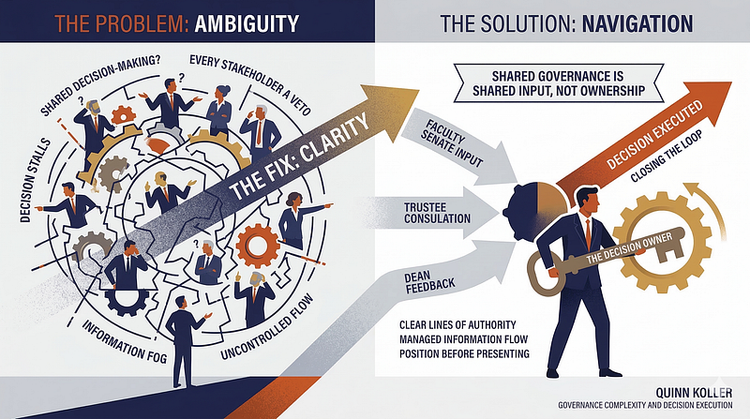
Portfolio decisions get challenged. That’s a feature of shared governance, not a flaw. The question isn’t whether your decisions will be questioned. They will be. The question is whether they hold up.
Defensible decisions have three characteristics.
They are based on criteria that were established before the decision, not after. Post-hoc rationalization is easy to spot and easy to attack. When the sort criteria are set at the beginning of the process, and applied consistently, the decision logic is visible. Challengers have to argue with the criteria, not the conclusion.
They are transparent about what was considered and what was not. A defensible decision doesn’t claim to have answered every question. It claims to have answered the right question with the available evidence. Acknowledging scope is not weakness. It’s the thing that makes a decision durable.
They separate the analytical conclusion from the institutional recommendation. The data says what the data says. The recommendation accounts for context: faculty capacity, accreditation timing, strategic priorities, political reality. These are different steps. When they get conflated, decisions become hard to defend because it’s unclear which part is evidence and which part is judgment.
The SPT Framework builds defensibility into the process by forcing these elements to be explicit before the politics arrive, not after.
What This Looks Like in Practice
A regional provost called me after fourteen months of portfolio review produced zero decisions. Every program was under review. Every review triggered new data requests. Every data request generated new questions. Faculty felt surveyed to death. Leadership felt no closer to action.
We started over with one rule: use only the data you already have.
In one working session, we sorted the full portfolio. Eighteen programs moved to Clear immediately. Seven got Investment priorities assigned the same week. Nine went into focused Review with specific questions, leads, and deadlines.
Six weeks later, every bucket had outcomes. Three programs were sunsetted with a rationale that held up in faculty senate. Two were restructured. Four were formally affirmed. The provost put it plainly: “We had the data the whole time. We just never sorted it.”
Progress was not blocked by information. It was blocked by process without decision points.
The Difference Between a Framework and a Substitute for Decisions
Institutions adopt frameworks. Run the process. Produce the report. Then nothing happens.
When that occurs, the framework became the substitute. It replaced the decision it was supposed to enable.
The SPT Framework is designed against that failure mode. The sort session ends with recorded decisions, not a recommendation for further review. Review-bucket programs have deadlines, not open-ended analysis windows. The output at every stage is a decision, not a document.
There is a version of rigor that produces reports. There is a version that produces decisions. They feel similar from the inside. From the outside, one of them results in programs still in limbo a year later.
The goal is fewer programs in limbo. That’s it.
Start Here
If your institution is in the middle of a portfolio review that has stalled, the fastest intervention is the sort session. One meeting. Existing data. Three buckets. Clear outcomes for everything that isn’t genuinely uncertain.
You don’t need new software. You don’t need a new committee. You need a two-hour session and the discipline to actually sort.
If your review hasn’t started, begin with the sort criteria. Before any data is collected, before any committees are formed, decide what a Clear program looks like. What an Invest program looks like. What a Review program looks like. Get leadership aligned on those definitions. Everything that follows will move faster.
Portfolio triage isn’t analysis. Triage is sorting so analysis goes where it counts.
The institutions that get this right don’t have better data. They stopped treating the process as the point.
Quinn Koller advises university presidents and provosts on governance, portfolio strategy, and decision execution. If your portfolio review has stalled, a short off-the-record conversation is often the fastest way to diagnose what’s blocking it.