The Definitive Playbook for Execution Readiness and Narrative Control
Most leaders think they are ready to execute. The calendar is full. The strategy is written. The right people are in the room. And still — decisions stall, timelines slip, and someone else ends up owning the story.
That is not a strategy problem. It is a narrative and ownership problem. And until leaders name it clearly, they keep solving for the wrong thing.
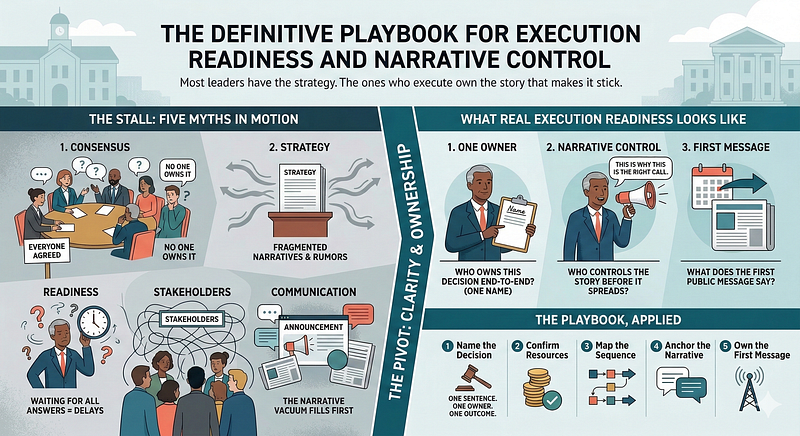
The Five Myths Running the Room
I work with presidents and provosts every week. Smart people. Deep expertise. Real urgency. The institutions they lead face genuine pressure — enrollment headwinds, resource constraints, faculty governance complexity, boards that want answers. These are not people who lack intelligence or commitment.
And still, execution breaks down. Almost always, the same five myths are running the room.
Myth 1: Consensus means you are ready.
Consensus is input. It is valuable input. But one person executes. When an institution mistakes “everyone agreed” for “someone owns it,” decisions die in the gap between the meeting room and the org chart. The people who agreed become spectators. The owner was never named.
Myth 2: A good strategy speaks for itself.
It doesn’t. Never has. A strategy document is a hypothesis. What happens to it depends entirely on who controls the story around it — before it’s announced, during rollout, and especially when pushback arrives. No strategy survives without narrative control.
Myth 3: Readiness means having all the answers.
This one costs leaders the most time. Waiting until every question is resolved before moving is how 18-month delays happen. Readiness does not mean certainty. It means knowing who decides — and when. The rest gets worked out in motion.
Myth 4: More stakeholders improve execution speed.
They don’t. Broader input can improve decision quality. Diffused ownership kills execution speed, every time. These are different things. Confusing them is how institutions end up with eight people “responsible” for an outcome that no one actually owns.
Myth 5: Communication happens after the decision.
This is the most dangerous myth. By the time the announcement goes out, the narrative has already started forming — in hallways, in faculty senate, in the inbox of the local reporter who covers higher ed. Narrative control starts before the first meeting. If you wait until after the decision to shape the story, you are already behind.
These myths feel like caution. They operate like brakes. And they are so embedded in academic culture that most leaders don’t recognize them as myths at all. They look like diligence. They feel like thoroughness. They are neither.
What Real Execution Readiness Looks Like
I built a solid plan once. The data was clear. The work was done. The analysis would have held up in any committee review.
We still lost control of the story.
That was the moment that changed how I think about execution. I had been preparing to execute. I had not been owning the outcome. Those are different disciplines, and conflating them is expensive.
Real execution readiness means three things:
Who owns this decision end to end? Not who has input. Not who has veto authority. Who is accountable from the moment the decision is made until the outcome is delivered? One name. One throat to grab if it stalls.
Who controls the story before it spreads? Every significant institutional decision generates a narrative vacuum. Faculty fill it. Staff fill it. The local paper fills it. If the leader doesn’t move first with a clear, honest account of what was decided and why, someone else will — and their version will travel faster.
What does the first public message say? Not eventually. First. The first message anchors perception. It sets the frame. Every subsequent communication either reinforces that frame or fights against it. Get the first message right, and the rest of the communication strategy is easier. Get it wrong, and you spend weeks correcting a story you should have owned from day one.
Everything else — the timeline, the task assignments, the status reports — is supporting structure. Valuable, but secondary. The three questions above are the frame.
The Three Mistakes Leaders Make Before a Decision Lands
Leaders at well-functioning institutions don’t usually make bad decisions. They make good decisions badly. That distinction matters, because the correction is different.
Mistake 1: Deciding without a narrative.
A decision without a story is a memo. And memos get interpreted. Faculty fill the silence with their own story. Staff assume the worst. Boards read the absence of explanation as evasion. The decision maker chose — and then went quiet. That silence is never neutral. It always gets filled, and rarely in the direction the leader intended.
The fix is simple and takes twenty minutes: before the decision is announced, write two sentences explaining why it is the right call. Not the process. Not the caveats. Why it is right. That is your narrative anchor. Use it in every conversation that follows.
Mistake 2: Skipping execution readiness.
The plan looks solid on paper. It clears every committee. Then it hits the org chart and stops. No one owns the outcome. Timelines are aspirational rather than real. Resources were assumed, not confirmed. The budget conversation was deferred. The staffing question was left vague.
Ready to decide is not the same as ready to execute. The gap between those two states is where most institutional momentum dies.
Before any decision moves to implementation, three questions need clean answers: Who owns it? What has to happen, in what order, by when? Are the resources confirmed — not assumed, confirmed? If any of those answers is unclear, the decision is not ready to execute. It is ready to stall.
Mistake 3: Letting the narrative drift.
You announced. You moved on. Someone else kept talking. A faculty senator framed the restructuring as cuts. A local reporter called the program review a crisis. Your version was accurate. Theirs traveled faster.
The first story usually wins. Not because it is more true, but because it gets there first and fills the vacuum before the correction can. Narrative control is not spin. It is the discipline of making sure your honest account of events reaches the relevant audiences before anyone else’s interpretation does.
The Fifteen-Minute Fix for a Stalled Decision
Most stalled decisions are not stuck because of bad strategy or missing information. They are stuck because no one named the actual decision clearly.
Before your next stalled decision, run this sequence. It takes fifteen minutes.
Step 1: Name the actual decision.
Not the topic. Not the issue area. Not the “situation.” Write one sentence that names the decision, identifies one owner, and specifies one outcome. If you cannot write that sentence, the decision is not ready to move. That is the problem to solve first.
Step 2: Identify who is blocking it.
Not enemies. People without clarity on their role. Write the name. Write what they need to hear. Most institutional friction is not resistance — it is confusion about authority, ownership, or sequence. Give those people the clarity they need, and the friction often disappears.
Step 3: Control the narrative first.
Draft two sentences explaining why this decision is right. Do it before anyone asks. That is your narrative anchor. When the first question comes — from a board member, a dean, a department chair — you already have a direct, honest answer ready. You are not reacting. You are setting the frame.
One decision owner. One clear outcome. Two sentences of narrative, ready before the pushback arrives. That is the system. It is not complicated. Most leaders skip it because it feels too simple to matter. It matters more than almost anything else in the execution sequence.
What Changes When It Works
A provost came to me mid-fall. Two program decisions were eighteen months overdue. Faculty were restless. The board was asking the same questions repeatedly. The narrative on campus had already shifted, and not in her favor.
We worked on three things: decision ownership — who had the call, not just the input; execution sequencing — what had to happen, in what order, by whom; and narrative control — what story she told, when, and to which audience.
By end of semester, both decisions were made. Faculty didn’t love every outcome. But they understood it, and they stopped filling the silence with their own interpretations. The board stopped looping back to questions that had already been answered.
That is not a miracle. That is clarity doing its job. When the decision is named, the owner is identified, and the narrative is anchored before the announcement, execution stops stalling. The work is still hard. The politics are still real. But the machinery moves.
The Playbook, Applied
Execution readiness is not a project. It is a discipline — one that has to be built into how institutional leaders approach every significant decision, not just the ones that are already in crisis.
The sequence is:
- Name the decision. One sentence. One owner. One outcome.
- Confirm the resources. Not assumed. Confirmed.
- Map the sequence. What has to happen first, second, third — and by whom.
- Anchor the narrative. Two sentences, drafted before the announcement, before the pushback, before the first question arrives.
- Own the first message. Get it to the right audiences before anyone else frames it for you.
This is not a checklist to run once. It is the operating logic that separates institutions that execute from institutions that plan to execute. The difference between those two things is not intelligence or resources. It is clarity — on ownership, narrative, and timing.
Most leaders have the strategy. The ones who execute own the story that makes the strategy stick.
Quinn Koller works with presidents and provosts at institutions navigating governance complexity and execution bottlenecks. If your campus has decisions that should be done by now, he is open to a short, off-the-record conversation.